
I invested a few days this week attending the Andrus Center Women in Leadership Conference. As you get a bit older, you wonder if you can still learn and apply new thoughts and skills. This was the 14th year I have attended the two-day event, which includes more than 650 attendees, most of them women. I looked forward to five excellent keynote speakers, as well as the opportunity to support the work and legacy of Cecil Andrus.
“What would you do if you were not afraid to fail?” Four women began an 8,446-mile journey from San Francisco to Australia. Their six-month journey turned into nine months. Oh, and they were traveling in a seaworthy rowboat.
A compelling analogy from their story is that “everyone has a Pacific to cross” as part of life’s journey. One should never underestimate the power of the human spirit. Filmmaker Sarah Moshman, who brought the documentary to life, has built a career telling the stories of ordinary women doing extraordinary things. Losing Sight of Shore tells the story of the courage required to begin such a journey and the persistence and resilience needed to finish it.
Sarah encouraged the audience by reminding us that, most often, you must “do things before you are ready.” Moshman is currently working on the story of astronaut Christina Koch, an engineer who served as a mission specialist on the recent Artemis II mission around the moon. Coming soon is the story of Alyssa Carson, who, at age 13, declared she would become the first person on Mars. Sarah shared that empathy for others is a driving force in her work.
Dr. Wanjiru Kamau-Rutenberg is a force of nature. Born in Kenya, she moved to live with relatives in Denver at age 16 because it was her only path to an education. The first shock was the snow, followed by almost everything else in her new world. She completed high school in Denver, earned a scholarship to Whitman College in Walla Walla, and later received both a master’s degree and a Ph.D. from the University of Minnesota.
“To whom much is given, much is expected” is a belief that has fueled her work supporting Black students and their ambitions to earn leadership positions. She believes we have a duty to give back to our communities and ecosystems. When asked what her secret power was, Wanjiru responded, “Audacity,” the confidence to push forward despite obstacles and setbacks.
The interviewer was a Boise State student-athlete who had been given the challenge of hosting the fireside chat. At one point, she spoke about overcoming fear, sharing advice she uses when coaching runners: “Forget Everything And Run.” She told me it is her way of setting aside the anxiety that accompanies each event and focusing only on the goal.
I enjoyed and learned from each of the five keynote speakers. I may tell you more next week, but I was particularly moved by the words of Corinne Sams, who serves as a board member of the Confederated Tribes of the Umatilla Indian Reservation.
Cor shared her personal story of overcoming drug and alcohol abuse before returning to her tribe and finding value and meaning in her faith and culture. She told the audience the Creation story that forms the basis of their belief system and their commitment to speaking for the earth and its resources.
We learned about the importance of salmon to their lives, livelihoods, and culture, and about generations of tribal fishers. Speaking of the period before the damming of N’chi Wana, the great river, the Columbia, she described salmon runs so abundant that people said you could walk across the river on their backs. Those runs have declined from more than 20 million fish to approximately 1.2 million last season.
The Treaty of 1855 protected many tribal lands and hunting rights. Unsurprisingly, the treaty was violated before it was even a year old and has only recently received modest protection through Supreme Court rulings. The tragic stories of the Cayuse, Walla Walla, and other tribes have been repeated across our country throughout the years as we immigrants took advantage of our power.
Cor was optimistic that her efforts, along with those of other tribal leaders, would continue to revitalize their culture and that one day the great river would flow freely again when alternative energy sources allow the dams to be removed.
The book club recently read This Vast Enterprise, a new history of Lewis and Clark. The book is told from multiple perspectives and is a great listen. Thinking of Cor’s remarks, you gain a deeper appreciation for the contributions of the tribes that befriended, traded with, and assisted Lewis and Clark during their journey. Sacagawea played a key role in their eventual success, as did York, the enslaved Black man who accompanied Clark. York earned the respect of the expedition despite the prejudice he faced.
The expedition was intended to map a route to the Pacific and stake claims to the land. In the end, it serves as a sobering commentary on westward expansion and the methods used to gain control of land and resources.
Cor described a $1 billion Columbia River revitalization plan that was negotiated with the Biden administration. Years in the making, the plan prioritized the health of the river while recognizing that the dams needed to remain in place until energy alternatives could replace them. Funding for upgrading and expanding fish ladders to help salmon on their return journey was later eliminated.
The tribal faith calls on each member to speak for the salmon, deer, grains, and water, thanking them for the nourishment they provide. It would be wise for all of us to stand up for our planet.
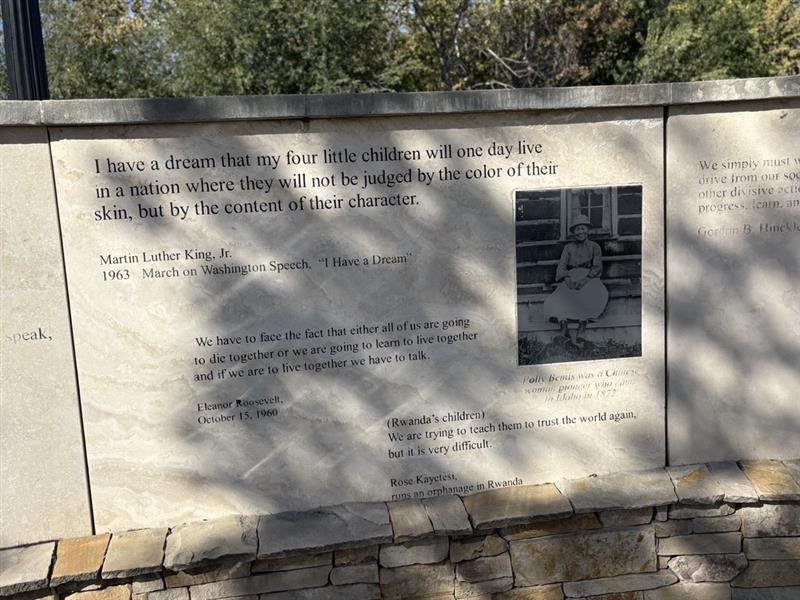
I also walked through the Anne Frank Memorial during my time on campus. I appreciated the messages from the past.
Mike